
Redefining the Half Halt Beyond the Reins
The half-halt is often taught as a simple sequence of closing the fingers, receiving a response, and releasing. That description is useful only as a starting point. When the hands become the primary braking mechanism, the rider may slow the visible movement without improving the horse’s balance. The result is frequently a shorter neck, a heavier contact, a blocked back, or a horse that learns to wait for the rein rather than remain attentive to the seat.
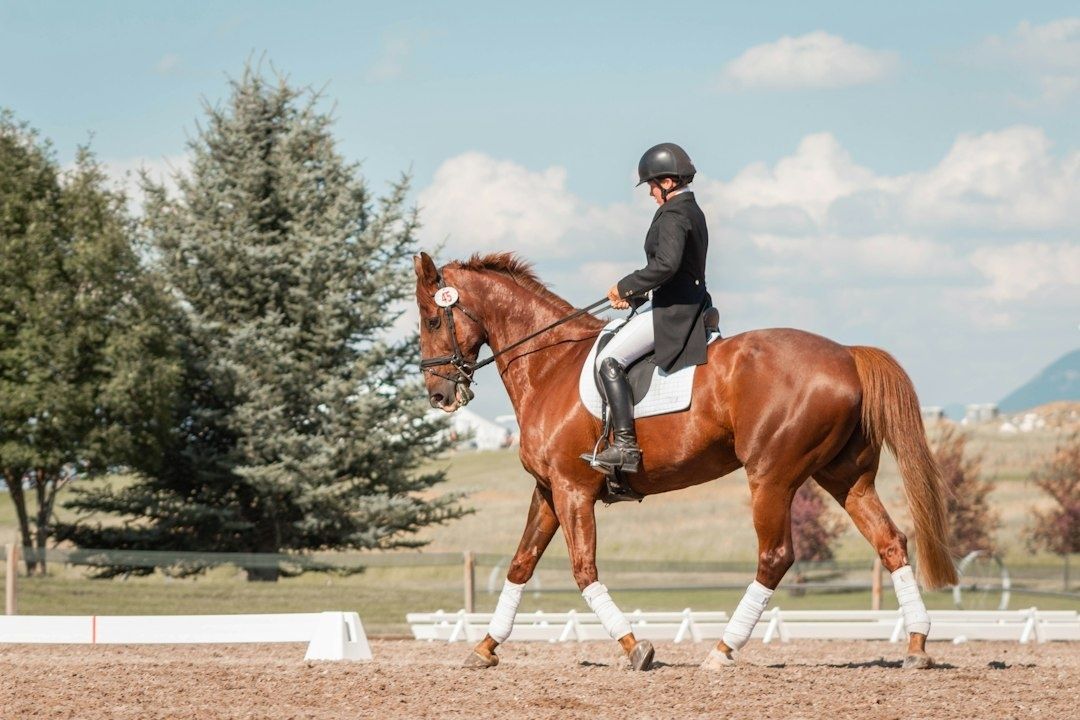
A genuine half-halt is better understood as an instantaneous kinetic query. The rider briefly reorganizes the flow of movement and asks, without interrupting impulsion, whether the horse can carry more weight behind, stabilize the trunk, and preserve the intended cadence. The hand may complete the conversation, but it should not initiate a backward struggle. Classical explanations of this aid consistently point toward communication through the rider’s seat and body, as described in this overview of the classical half-halt. Collection therefore emerges from coordinated biomechanics, not rein-dependent restraint. The horse remains forward because the aid improves organization rather than suppressing energy.
Rider Biomechanics and Isometric Core Deceleration
The rider’s first responsibility is to establish a stable platform without becoming rigid. A neutral pelvis permits the seat bones to follow the horse’s movement while the torso remains vertically organized above them. The pelvis should not be tipped excessively forward, which can hollow the lower back, or tucked aggressively underneath, which can flatten the lumbar region and restrict the horse’s back. Above it, the thorax must remain quietly stabilized so that the shoulders do not fall behind the motion during the half-halt.
Core engagement in this context is subtle and isometric. The deep abdominal system, including the transversus abdominis, can provide momentary support around the trunk without producing a visible crunch or a gripping action through the thighs. The rider should feel taller and more centered, not compressed. The hip joints remain soft enough to absorb the horse’s movement, while the upper leg maintains contact through length rather than clamping. This distinction is essential: muscular effort should organize the rider’s skeleton, not close the joints that allow the horse to move freely.
During a correct half-halt, the rider briefly decelerates the movement of the trunk. This is not a backward pull and not a deliberate attempt to stop the horse. It is a momentary change in the rider’s inertia, communicated through the seat, legs, and, when necessary, a light closing of the fingers. The horse feels a more stable center of mass and is invited to rebalance around it. Biomechanical explanations of the training scales emphasize that rhythm, suppleness, contact, impulsion, straightness, and collection remain interconnected, so a half-halt cannot be isolated from the quality of the rider’s position.
- Maintain a pelvis that is neutral enough to follow the gait.
- Stabilize the rib cage without lifting the shoulders or holding the breath.
- Engage the deep abdominal wall briefly rather than bracing the entire body.
- Keep the hip joints open and the upper legs long.
- Allow the hands to remain elastic and forward in relation to the horse’s mouth.
Equine Biomechanics and Lumbosacral Engagement
The horse does not mechanically copy the rider’s posture, but a well-timed stabilizing aid can influence how the horse organizes its own movement. When the rider’s trunk momentarily becomes more stable, the horse receives a clearer invitation to rebalance. The desired response includes greater flexion through the lumbosacral region, increased activity of the hind limbs, and a more supportive connection through the abdominal and thoracic structures. This should be viewed as a reciprocal response, not as a lever operated by the rider.
As the hindquarters accept more load, the horse can place a hind foot farther beneath the body while maintaining rhythm. The center of mass shifts relatively toward the rear, the forehand becomes lighter, and the stride may become shorter, higher, and more elevated without losing forward energy. Collection is not a separate gait. It is a trained quality within walk, trot, or canter, and its appearance must be appropriate to the horse’s age, strength, conformation, and stage of education.
The thoracic sling is equally important. Muscles supporting the rib cage between the forelimbs help the horse elevate the base of the neck and free the shoulders. This is why a convincing uphill balance cannot be manufactured by raising the horse’s head with the reins. The neck may appear elevated while the back remains hollow and the hindquarters disengaged. Correct training instead links lumbosacral flexion, abdominal support, thoracic lift, and relaxed contact. Such a reciprocal response should be developed with the horse’s confidence and welfare in mind. The broader principles described in Is Your Horse A Happy Athlete? place happiness, communication, and healthy biomechanics before the outward appearance of advanced work.
| Rider action | Desired equine response |
|---|---|
| Momentary trunk stabilization | Reorganization of balance without loss of forward intent |
| Soft closing of the upper leg | Maintenance of the horse’s line and energy |
| Elastic finger closure | Brief clarification of the connection, followed by release |
| Stable, following seat | Greater lumbosacral flexion and hindquarter participation |
| Immediate return to neutral | Preservation of self-carriage and relaxed contact |
The Execution Protocol for a Fluid Half Halt
Timing and proportion determine whether the aid is corrective or disruptive. The sequence should feel almost instantaneous, with the rider’s body preparing the response before the hand says anything. In a well-trained horse, the aid becomes increasingly subtle because the horse learns to recognize the rider’s change in balance before a stronger signal is required.
- Prepare with the breath. Exhale softly and allow the breath to settle the rib cage. Avoid holding the breath, since respiratory tension commonly spreads into the shoulders, hands, and seat.
- Stabilize the center. Engage the deep abdominal wall for a brief moment while keeping the pelvis mobile and the lumbar region free.
- Close the upper leg. Maintain the horse’s forward intention and prevent the half-halt from becoming a backward request.
- Close the fingers. If clarification is needed, close the fingers quietly around the reins without pulling the elbows behind the torso.
- Release immediately. Return to an elastic hand and a following seat as soon as the horse responds, allowing the new balance to continue.
The most useful moment is often associated with the stance phase of the inside hind leg, when that limb is accepting weight. Exact timing varies with gait, line, bend, and the horse’s individual movement pattern, so the rider should learn to feel the inside hind leg rather than apply the aid by rote. In trot, the half-halt may be coordinated with the diagonal pair that includes the inside hind. In canter, the rider can sense the three-beat sequence and use the moment when the inside hind contributes to the body’s support and propulsion.
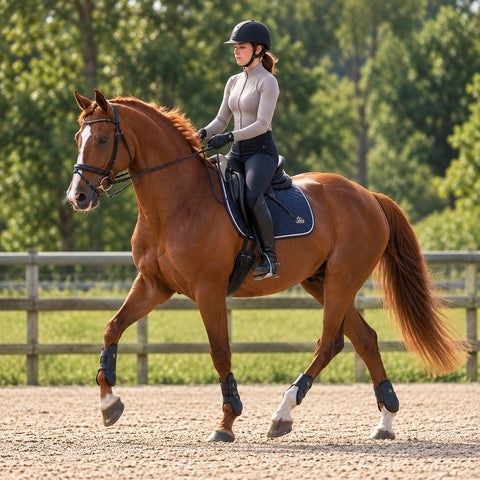
A frequent arena error is the backward hand. The rider feels instability, closes the fingers, and continues drawing the reins toward the body after the horse has already offered a response. This blocks the base of the neck and encourages the horse to shorten in front rather than sit behind. Another error is a collapsed hip angle, in which the rider folds at the waist and loses the vertical relationship between shoulders, pelvis, and heels. The aid then becomes a torso movement that disturbs the horse instead of a controlled deceleration.
Restricted breathing is equally revealing. A rider who inhales sharply or holds the breath may create a moment of tension that the horse interprets as alarm or resistance. The half-halt should feel quieter than a major transition. If the horse becomes hollow, slows abruptly, braces against the bit, or loses rhythm, reduce the intensity and return to a clear forward gait before trying again. A smaller aid delivered at a better moment is more valuable than a powerful aid delivered late.
- Check that the horse remains in the same rhythm after the aid.
- Observe whether the neck lengthens toward the contact instead of retracting.
- Confirm that the hind legs remain active rather than merely producing a slower tempo.
- Release before the horse has to defend the mouth or poll.
- Repeat only when the previous response has settled into the movement.
Progressive Arena Exercises to Test Self Carriage
Begin with transitions within the gait along the long side. Ride several strides of a forward, regular working trot, then ask for a slightly shorter and more elevated trot while preserving the same tempo. The rider should organize the trunk, support with the upper leg, and allow the hands to remain quiet. After a few balanced strides, return to the original expression. This exercise shows whether the horse can add carrying power without relying on rein pressure.
The same principle can be applied in canter by asking for a modest compression of the stride followed by a forward canter. The change should be measured rather than dramatic. A horse that merely slows may be losing impulsion; a horse that lengthens its frame and rushes may not have understood the organizing aid. The successful response is a shorter stride with increased articulation, a stable rhythm, and a soft return to the longer version.
Downward transitions on a 20-meter circle provide another precise test. Establish an even trot or canter, maintain the bend through the circle, and use the seat and core to prepare the downward transition before asking with the reins. The circle encourages the horse to remain attentive to the inside hind while the rider monitors straightness through the shoulders. The transition should not fall inward or become dependent on a tight inside rein.
- Ride walk to trot and trot to walk while preserving a forward connection.
- Ask for canter to trot on the circle with the shoulders aligned to the curve.
- Use frequent transitions, but allow sufficient time for the horse to find balance between them.
- Stop if the horse loses rhythm, bends the neck, or begins to anticipate tension.
The give-and-retake rein test is a valuable benchmark of self-carriage. Once the horse is balanced, briefly soften or advance one or both hands without changing the seat or the line. A horse carrying itself should preserve rhythm, direction, and a stable outline for several strides. If the horse immediately falls onto the forehand, raises the head, slows, or drifts, the apparent balance was probably being maintained by the reins rather than by the hindquarters.
This test should be introduced conservatively and with a clear return to the normal elastic contact. It is not a challenge to be forced, nor should it be used to expose a horse that is tired or anxious. The aim is diagnostic: to determine whether communication, happiness, and healthy biomechanics are developing together. A whole-horse approach, such as the training perspective outlined in the Happy Athlete framework, encourages riders to address confidence and partnership before intensifying technical demands.
Transform Your Partnership Through Biomechanical Precision
The half-halt becomes transformative when rein-bound force is replaced by coordinated balance. The rider’s stable yet breathing trunk, neutral pelvis, supple hips, supportive upper leg, and elastic hands create a moment in which the horse can reorganize its body without losing desire to go forward. From that moment, lumbosacral flexion and hindquarter engagement become possibilities the horse can develop, rather than positions imposed from the front.
For the next arena session, choose one gait, one line, and one clear objective. Feel the inside hind, breathe through the preparation, stabilize the core for an instant, support with the leg, and release before the aid becomes a restraint. Then test the result through a transition within the gait or a brief give-and-retake. The finest half-halt may be nearly invisible from the ground, yet its effect is unmistakable: a quieter rhythm, a lifted forehand, a carrying hindquarter, and an effortless conversation between horse and rider.