
Mastering the Triad of Modern Combined Driving
Combined driving is one of equestrian sport”s most demanding tests of partnership. A driver must guide a team through three distinct phases while preserving the horses” soundness, responsiveness, and confidence. The competition measures far more than speed. It examines harmony in dressage, stamina and judgment in the marathon, and exacting accuracy in cones. Across an international field, the smallest loss of rhythm, a hesitant turn, or an inefficient line can alter the final classification.
The team may include one to four horses or ponies, a driver, and one or two grooms, depending on the division and applicable regulations. The sport developed from classical carriage practice into a rigorously governed international discipline, with its history and modern structure outlined in this combined driving overview. At elite level, the driver”s hands, the navigator”s balance and communication, and the horses” collective movement must operate as one system. Dressage establishes control, marathon exposes tactical judgment, and cones demand composure after fatigue has accumulated.
Dressage and the Science of Dynamic Alignment
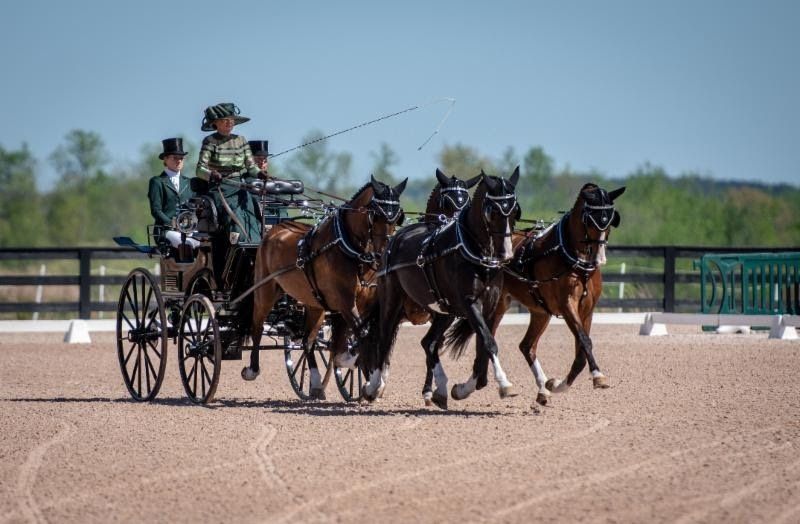
Dressage is often mistaken for a quiet opening ceremony before the more spectacular phases. In reality, it establishes the technical foundation for the entire competition. A multi-horse team must travel with impulsion, meaning purposeful forward energy, while remaining straight, elastic, and balanced through changes of pace and direction. The driver is not simply asking the horses to move forward. The objective is to coordinate the shoulders, backs, hindquarters, and tempo of the team so that the carriage appears to glide rather than resist the movement.
Four continuous reins require exceptional sensitivity. Each rein influences a particular horse and must be managed in relation to the others, while the driver also uses posture, weight, voice, and carefully timed rein adjustments. A quiet voice command may support a transition, but it cannot replace correct preparation. The groom”s position and the carriage”s stability also affect the team”s visual balance. Judges assess the quality of the movement, accuracy of the prescribed figures, obedience, suppleness, harmony, presentation, and overall turnout.
The strongest dressage performances are therefore built on disciplined detail rather than theatrical gestures. Judges look for regularity in the pace, evenness between horses, correct geometry, prompt but smooth transitions, and a consistent connection from the driver”s hands through the harness. Errors are conspicuous because the arena is deliberately controlled: there are no obstacles or changing surfaces to conceal an uneven rhythm. A team that remains composed at the halt, enters figures without drift, and finishes with the same energy it showed at the beginning has demonstrated the alignment required for the phases ahead.
- Impulsion: forward energy that remains controlled and balanced.
- Cadence: an even, deliberate rhythm that survives transitions and turns.
- Contact: a consistent connection through the reins without excessive tension.
- Accuracy: precise figures, straight lines, correct markers, and punctual transitions.
- Harmony: the visible impression that driver, horses, harness, and carriage function together.
The governing framework for international competition is the FEI Driving Rules, effective from 1 January 2026. Those rules sit alongside welfare requirements that place the horse”s fitness, training, management, rest, veterinary care, and safe competition conditions above competitive interests.
Marathon Dynamics and High-Speed Navigator Communication
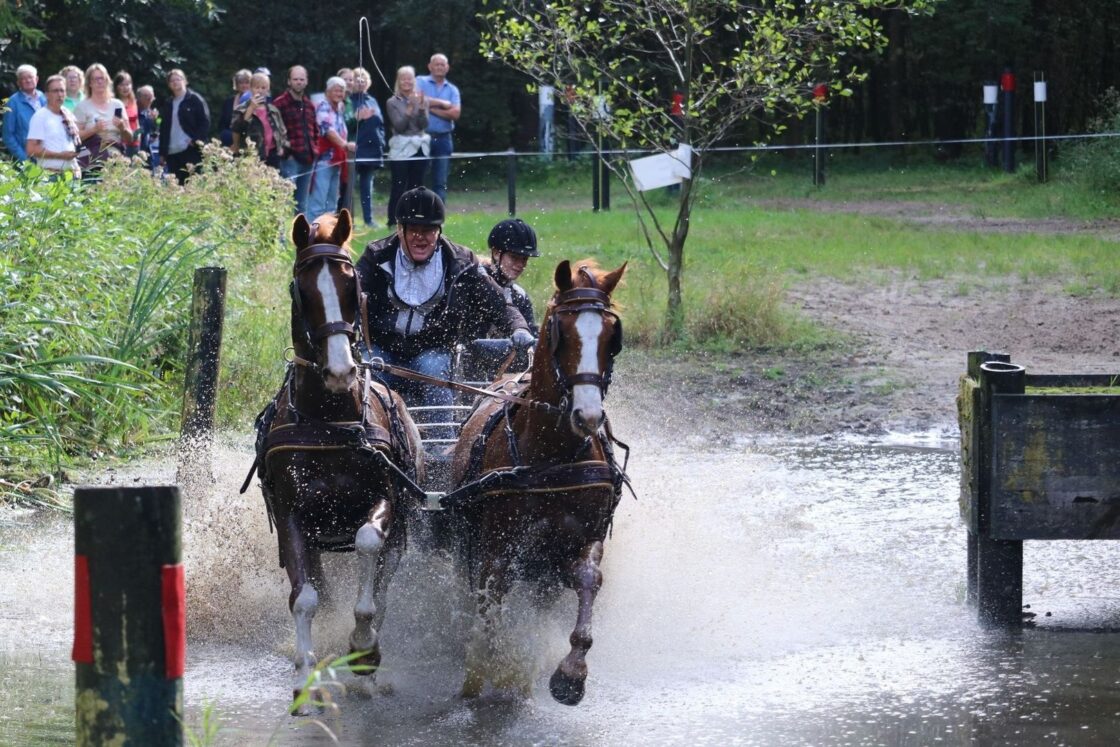
The marathon changes the character of the contest immediately. Instead of presenting balance within a marked arena, the team must carry speed across varied terrain and negotiate a sequence of obstacles with accuracy. Braking, turning, acceleration, and surface changes create constant shifts in kinetic energy. As the carriage enters a turn, its mass continues moving outward; as it slows before a narrow passage, the horses and passengers must absorb the change without losing rhythm or confidence.
The navigator, traditionally called a groom in many contexts, is central to this process. Communication must be concise because the team is moving too quickly for lengthy explanations. The navigator identifies the next gate, confirms the intended line, monitors elapsed time, and shifts body weight to help stabilize the carriage. This physical ballast is not an improvisation. It is part of a rehearsed system in which the navigator anticipates the turn and positions the body before the carriage reaches the point where balance becomes critical.
Timing is equally strategic. A driver may gain time by attacking every obstacle, but excessive speed can produce a wider line, a missed gate, or a damaging loss of balance. At a major FEI World Championship, Boyd Exell”s marathon performance illustrated the value of controlled decision-making. Despite difficult, muddy ground, his strategy emphasized remaining among the leading competitors at each obstacle. He recorded 110.48 points, the day”s third-best result, and entered the final cones phase with a 5.38-point advantage over Dries Degrieck, while Chester Weber remained third. The result underlined an important principle: marathon success is not always the fastest isolated section, but the most effective combination of speed, accuracy, and risk management.
- Read the surface: assess firmness, mud, camber, and traction before committing to a pace.
- Protect the line: choose an efficient route that leaves enough margin for the carriage and wheel track.
- Synchronize the ballast: the navigator should shift weight before, not after, the decisive turn.
- Monitor the clock: compare progress with the intended split times without allowing the watch to disrupt the driving rhythm.
- Preserve the horses: manage effort so that the team reaches the final obstacle with control and recoverable fatigue.
The marathon also provides a powerful example of championship pressure. In the referenced Aachen competition, all 53 starters completed the phase without elimination, yet the standings remained tightly contested. Australia moved ahead in the Team competition, with the Netherlands only 2.31 points behind and Belgium a further 0.45 points back. Such margins show why the navigator”s information must be accurate, immediate, and trusted. A team does not need to dominate every obstacle; it must avoid the costly mistake that a rival is prepared to exploit.
Comparative Overview of Competition Phases
Each phase asks the same team to express a different form of competence. Dressage rewards visible harmony and controlled movement. Marathon rewards cardiovascular conditioning, tactical navigation, and courage under changing conditions. Cones returns the team to a measured arena, but with little margin for error and with the accumulated fatigue of the previous day still present. Equipment and presentation also change, reflecting the purpose of each test.
The transition between phases is itself a mark of professionalism. A formal dressage carriage emphasizes presentation and balance, whereas a marathon carriage is reinforced for demanding terrain and repeated changes of direction. Harness adjustments, wheel condition, tire or track preparation, horse care, hydration, feeding, and recovery planning all influence the next performance. The 2026 FEI framework covers carriages, harness, horse requirements, officials, and phase-specific procedures, while also requiring attention to veterinary support and safe surfaces.
| Phase | Equipment and setting | Primary driver focus | Principal physical demand |
|---|---|---|---|
| Dressage | Formal turnout, presentation carriage, marked arena | Rhythm, contact, geometry, transitions, and harmony | Controlled muscular effort and sustained balance |
| Marathon | Reinforced carriage, cross-country terrain, designated obstacles | Line selection, pace, split times, communication, and risk control | High cardiovascular load, rapid acceleration, braking, and lateral forces |
| Cones | Precision carriage, measured cones track, narrow clearances | Accuracy, speed, straightness, and concentration under time pressure | Recovery management, coordination, and fine motor control after marathon fatigue |
Recovery begins as soon as the marathon ends. Cooling, hydration, veterinary observation, careful feeding, and appropriate rest are not peripheral routines; they are essential to welfare and performance. A horse that appears willing may still require thorough assessment before the next phase. Spectators often see only the final cones round, but the quality of that performance is shaped by the care provided during the hours between competitions.
Precision Through the Cones Arena
Cones is a deceptively severe examination. The track may look clean and orderly, yet the carriage must pass between pairs of cones with only a small margin for error. A wheel can clear one obstacle while the carriage body or opposite wheel follows a different arc. The driver therefore rides the geometry of the entire vehicle, not merely the horses” heads. The ideal line accounts for wheelbase, turning radius, approach angle, surface grip, and the position of the next obstacle.
Mental endurance becomes decisive because cones follows the physical and emotional demands of marathon. The horses may be tired, the driver may be carrying accumulated tension, and the navigator must still deliver exact information. A quick but careless entry can produce a knockdown, while an overly defensive pace can surrender the advantage gained earlier. The best teams establish a repeatable rhythm, maintain a light but effective connection, and make each turn early enough that the carriage completes the arc without a last-second correction.
Training should reproduce the constraints of competition rather than relying only on wide schooling spaces. Progressive exercises can begin with generous clearances, then narrow the track as the team develops confidence. Drivers should practice both memorized courses and unfamiliar layouts, while navigators rehearse concise calls and body positioning. Ground conditions deserve equal attention. A venue with suitable arenas, safe access, and room for conditioning can support the gradual development of accuracy without overloading the horses.
- Use measured cones and record wheel clearances rather than relying on visual impressions alone.
- School transitions immediately before and after turns to test whether balance survives pressure.
- Vary the direction and sequence of exercises so the team responds to information rather than anticipation.
- Include recovery days and low-impact conditioning between demanding precision sessions.
- Choose facilities with appropriate surfaces, secure boundaries, and sufficient space for both driving and horse management.
Regional public infrastructure can also support foundational work when used responsibly and in accordance with local rules. JaxParks recreational spaces represent the scale of civic open-space provision available in Jacksonville, while dedicated equestrian facilities such as the Jacksonville Equestrian Center offer arenas, stabling, and more than 80 acres for horse-related activity. These venues are not substitutes for a purpose-built international course, but suitable open environments can help develop conditioning, straightness, ground-driving habits, and the calm repetition on which elite precision depends.
Elevate Your Understanding of Driving Mastery
Combined driving rewards the team that can change character without losing identity. In dressage, the driver and navigator cultivate visible order, even contact, and balanced movement. In marathon, they transform that foundation into efficient speed, using communication, physical ballast, and intelligent risk assessment. In cones, they return to exact geometry while managing fatigue. Across all three phases, the horse remains the central athlete, and every tactical choice must be measured against soundness, confidence, and recovery.
For spectators, the most revealing approach is to watch the relationship between decisions rather than focusing only on the final score. Observe how the driver prepares a transition, how the navigator anticipates a turn, whether the horses maintain a common rhythm, and how a team responds after a difficult obstacle. Aspiring drivers should study the order of priorities: establish balance before demanding speed, rehearse communication before relying on it, and make welfare the condition for every ambition. That combination of cohesion, adaptability, and care explains the enduring prestige of international carriage sport. The finest rounds are not displays of force, but refined demonstrations of trust under pressure.