
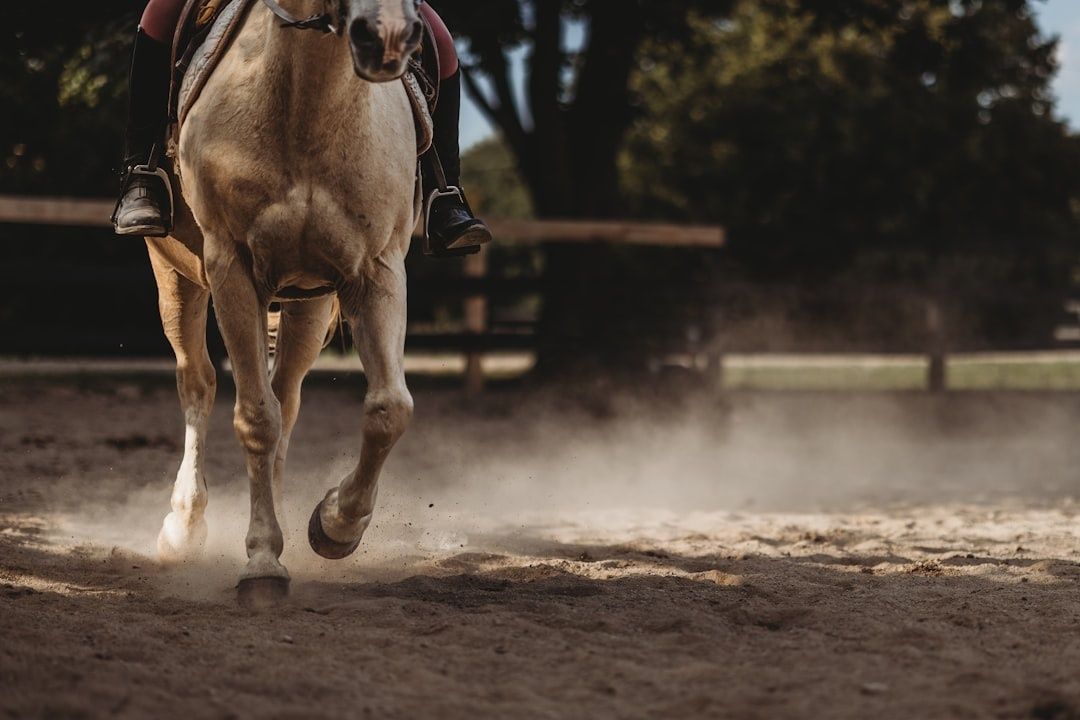
The Engineering Beneath Every Stride
In a modern competition arena, footing is not simply dirt placed beneath a horse. It is an active biomechanical system that interacts with every landing, loading phase, turn, transition, and departure. Its behavior determines how quickly impact is absorbed, how securely the hoof engages with the ground, and how much energy is returned to the limb during propulsion. For an elite sport horse, those details accumulate over thousands of strides during training and competition.
The central challenge is to create a surface that supports athletic expression without transferring excessive stress to bone, tendon, ligament, or joint. A surface that is too hard may amplify concussion and contribute to subchondral bone overload, while footing that is too deep, unstable, or adhesive can increase muscular fatigue and soft tissue strain. The Equine Surfaces White Paper presents this balance as a continuing field of scientific development, linking surface composition, construction, maintenance, and measurable physical properties with the orthopedic demands of sport. Across international venues, the quality of footing is therefore part of performance management, not merely an element of arena presentation.
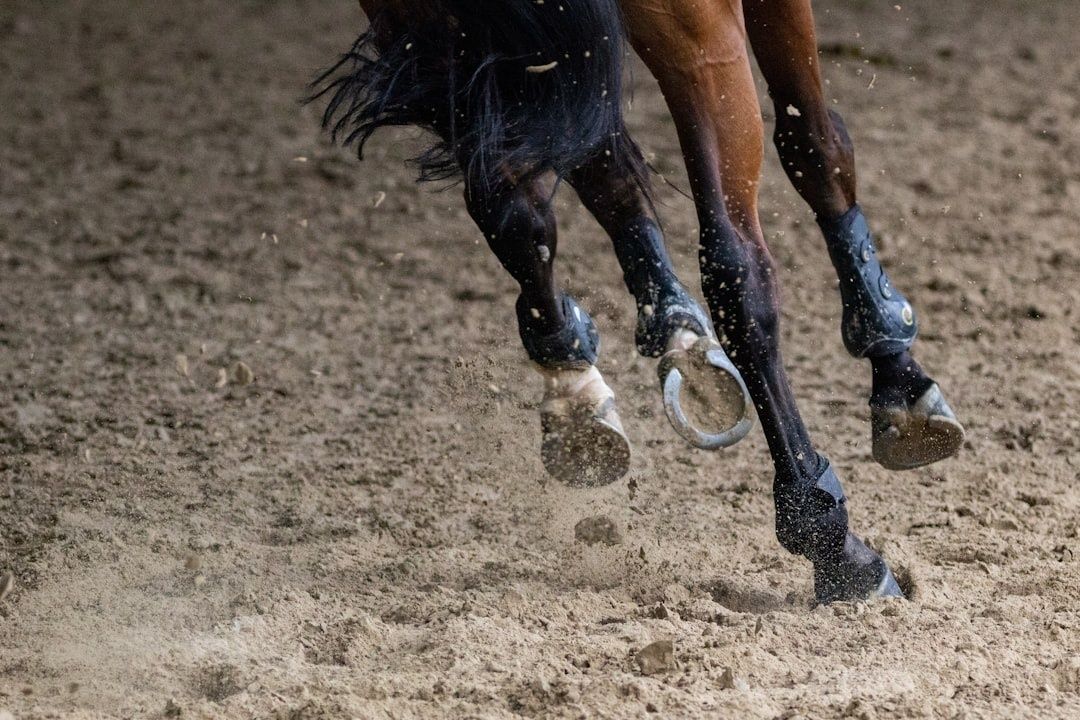
Biomechanical Anatomy of the Three Footfall Phases
Each stride can be understood through three overlapping phases. During initial landing, the hoof meets the surface and may slide a short distance before becoming fully loaded. This controlled slide is important because it can reduce the abruptness of collision. If the surface stops the hoof instantly, a larger proportion of the impact may travel as high-frequency shock through the hoof capsule, phalanges, pastern, fetlock, and proximal limb. If the surface allows excessive penetration or uncontrolled movement, however, the horse may lose stability and expend unnecessary muscular effort.
The loading stance follows as the hoof accepts the combined forces generated by the horse and rider. The fetlock descends, the suspensory apparatus and flexor tendons stretch, and the limb stores and dissipates mechanical energy. A suitable cushion reduces the sharpness of the peak vertical force while preserving enough support for the horse to remain balanced. The third phase is rollover and push-off. As the heel lifts and the limb rotates over the toe, traction, shear resistance, and toe penetration determine whether propulsion is efficient or whether the limb is exposed to excessive torsion.
These demands vary substantially by discipline. A show jumper may land from height with considerable forelimb loading, followed by rapid turning and acceleration toward the next obstacle. An extended dressage movement places different demands on the surface, including repeated diagonal loading, lengthened stride mechanics, collection, and controlled lateral work. The horse must be able to engage the ground without slipping, but the footing must not lock the hoof in place during rotation. Detailed biomechanical investigations supported by international federations highlight how surface resistance alters breakover strain on distal limbs, as documented in the Equine Surfaces White Paper.
- Landing: The surface should provide predictable deceleration, modest hoof slide, and sufficient cushioning to reduce abrupt shock transmission.
- Loading: The footing must support the hoof while moderating peak force and limiting excessive strain on the fetlock, suspensory ligament, and flexor structures.
- Breakover: The toe should release consistently, with enough shear resistance for propulsion but not so much traction that rotation becomes restricted.
Core Surface Parameters and Orthopedic Load Profiles
Impact firmness and cushioning are related but not identical. Firmness describes how strongly the surface resists penetration, while cushioning concerns the extent to which impact energy is absorbed. A very firm surface may offer excellent stability but return a high shock load to the limb. Conversely, a deeply cushioned surface can soften impact yet force the horse to work harder to lift the hoof and stabilize the joints. That additional effort may produce fatigue, shortened movement, or compensatory loading elsewhere in the body.
Grip and shear resistance must also be calibrated carefully. During take-off, a horse needs sufficient traction to direct force into forward movement. During landing and turning, however, a small degree of hoof slide can reduce rotational stress. Excessive grip may place the deep digital flexor tendon, collateral ligaments, and joint capsules under higher torsional loads, particularly when the limb is planted while the body changes direction. Elasticity and rebound add another layer. Sand blended with textile or elastic fibers can alter how the surface deforms and recovers, potentially improving resilience and energy return when the blend is correctly selected and consistently maintained.
| Surface property | Performance benefit | Risk when poorly controlled |
|---|---|---|
| Firmness | Stable support and precise foot placement | Increased concussion and subchondral bone loading |
| Cushioning | Reduced impact peaks and softer landings | Excessive depth, fatigue, and unstable joint loading |
| Shear resistance | Traction for propulsion and turns | Restricted rotation and higher tendon or ligament strain |
| Elasticity | Energy storage, rebound, and responsive movement | Inconsistent reactions and altered stride timing |
| Uniformity | Predictable biomechanics across the arena | Localized overload, slipping, or abrupt changes in limb loading |
Anatomy of a Grand Prix Arena Foundation
A high-level arena begins below the visible riding layer. Most engineered systems contain a prepared sub-base, a compacted base layer, and the upper footing. The sub-base must provide structural support while allowing water to move toward an effective drainage system. Outdoor arenas commonly incorporate a central crown or a carefully controlled slope, often in the range of 1 to 2 percent, so that rainfall does not remain trapped beneath the riding surface. If grading is irregular or drainage is inadequate, moisture may create soft zones, standing water, frozen patches, or progressive compaction.
The riding layer itself depends heavily on sand selection. Grain size, hardness, mineral composition, sorting, and particle shape all influence stability and drainage. Sub-angular silica grains generally interlock more effectively than very round river sands, although the correct choice depends on the complete arena design and local climate. Additives can then modify the behavior of the sand. Polypropylene geotextiles, polyester fibers, and elastic materials may bind particles, improve moisture retention, increase shear resistance, and reduce packing. Wax coatings can limit dust and help preserve consistency, but any additive must be assessed for compatibility with the existing sand rather than treated as a universal solution.
Consistency is the defining quality of a Grand Prix surface. A technically sophisticated blend can still become hazardous if grooming, irrigation, or traffic distribution is inadequate. A high-traction pocket at the end of a turn, a shallow section near the warm-up gate, or a compacted strip along the rail can change the horse”s limb mechanics within a single round. Facility managers should therefore treat the arena as a mapped system, recording depth, moisture, traffic patterns, and repair history rather than relying solely on visual appearance.
- Construct a stable sub-base with effective drainage and accurate grading.
- Select sand according to grain shape, mineral properties, climate, and intended discipline.
- Use fibers or textiles only after compatibility testing and controlled blending.
- Monitor the rail, entrances, corners, and take-off zones for localized compaction.
- Preserve uniform depth through systematic grooming rather than occasional heavy correction.
Practical Protocols for Moisture and Compaction Management
Daily management should begin with observation and measurement. Depth checks at the rail, centreline, corners, landing areas, and heavily used warm-up zones can reveal redistribution before it becomes a performance problem. Precision grooming should restore an even profile without damaging the crown or pulling base material into the riding layer. Moisture control is equally important. Irrigation should achieve consistent penetration rather than leaving a wet crust over dry material, and indoor arenas require particular attention to evaporation, dust, and localized drying caused by ventilation.
Objective testing provides a more reliable basis for decisions than rider impressions alone. The Orono Biomechanical Hoof Tester is a two-axis drop-tower device designed to reproduce aspects of hoof impact and sliding behavior. Its 30 kilogram mass produces approximately 540 joules of impact energy, while sensors record acceleration, load, position, and related variables. The procedure can assist with comparisons of impact and shear characteristics, although its dynamic response has not been established as a direct equivalent to a galloping horse. Testing should therefore complement, not replace, veterinary monitoring, rider feedback, visual inspection, and structured maintenance records.
- Check riding depth and surface distribution before high-intensity sessions and competitions.
- Adjust irrigation according to temperature, humidity, wind, cover, and recent traffic.
- Groom frequently enough to redistribute material without overworking the surface.
- Test representative zones, including corners, rails, landings, take-off points, and entrances.
- Remediate immediately when there is standing water, a hard crust, deep displacement, visible rutting, inconsistent rebound, or a sudden change in hoof slide.
Safeguarding Equine Athleticism from the Ground Up
Orthopedic protection begins with recognizing that footing is part of the horse”s training environment. Cushion, firmness, shear resistance, elasticity, moisture, and depth interact continuously with conformation, shoeing, speed, discipline, fatigue, and arena geometry. No single material can guarantee soundness, and no surface specification remains valid without maintenance. The strongest management programs combine engineered construction with regular testing, disciplined grooming, veterinary observation, and clear records that identify how the surface changes over time.
For trainers, course designers, and facility directors, the practical recommendation is straightforward: specify the biomechanical objective before choosing the material. Design drainage and base layers for the local environment, verify sand and additive compatibility, establish measurable maintenance thresholds, and retest after repairs or significant weather changes. The investment protects more than the appearance of a prestigious arena. It helps preserve training continuity, reduces avoidable orthopedic stress, supports confident competition, and safeguards the long athletic careers on which elite sport depends. In the quiet precision beneath every stride lies one of the most consequential decisions in equestrian facility management.